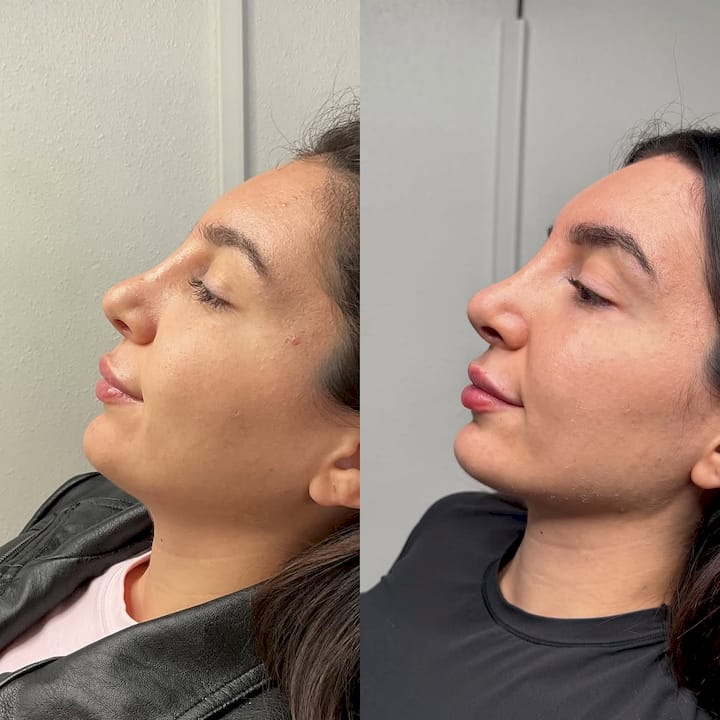
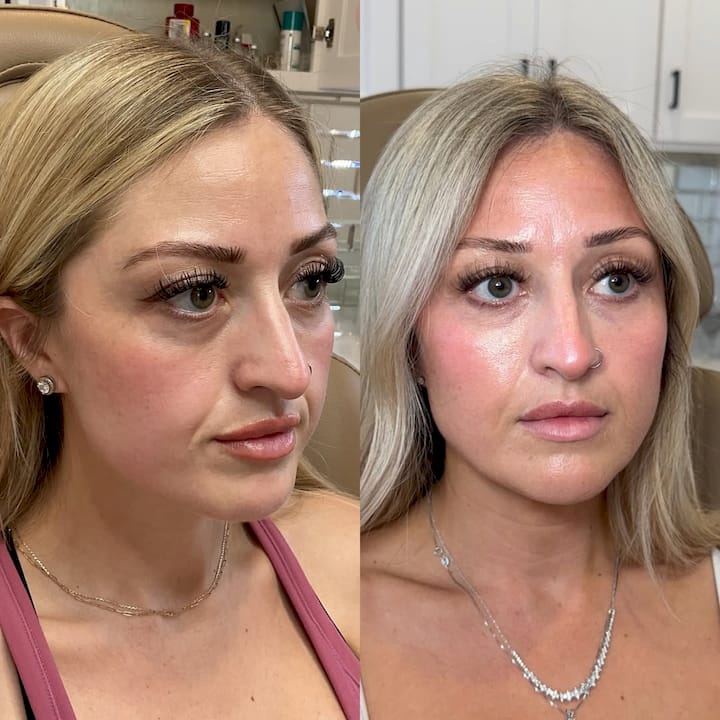
Most swelling from a liquid rhinoplasty peaks at 24 to 48 hours, then drops sharply over the next week, according to Dr. Scott Horsburgh’s clinical recovery guidance. Subtle residual puffiness can linger for an extended period while tissue settles into its final shape. That’s the normal path, and we want you to recognize it, so you’re not second-guessing every fluctuation in the mirror.
A small percentage of patients experience something outside that normal path, and those cases need attention fast:
-
Severe, sudden pain that feels disproportionate to the injection
-
Skin blanching (white or dusky gray patches) on or around the nose
-
Vision changes of any kind, even brief
If you notice any of these, contact your injector immediately or go to the emergency room. Don’t wait to see if it improves.
Hyaluronic acid fillers, the material behind most liquid rhinoplasty procedures, can be reversed with hyaluronidase if something goes wrong. Not every filler offers that safety net, which is one reason material choice matters as much as technique.
Key Takeaways
Liquid rhinoplasty swelling peaks within 48 hours, resolves substantially within one to two weeks, and requires immediate medical attention if you notice blanching, severe pain, or vision changes.
| Point | Details |
|---|---|
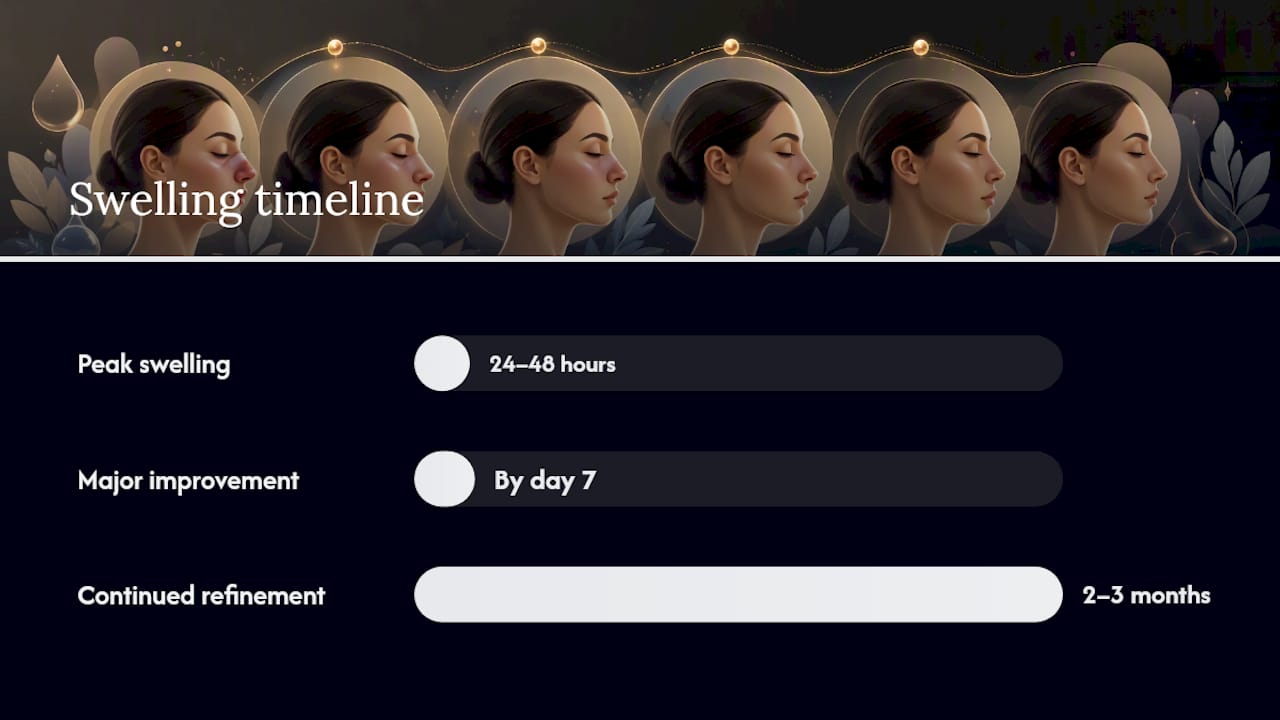
| Swelling timeline | Expect peak swelling at 24 to 48 hours, major improvement by day 7, and continued refinement through 2 to 3 months. |
| Emergency signs | Skin blanching, sudden severe pain, or vision changes mean contact your injector or go to the ER immediately. |
| Material matters | HA fillers like Juvederm and Restylane can be dissolved with hyaluronidase; many non-HA fillers cannot. |
| Delayed complications | Nodules or persistent swelling weeks to months later may need steroids, 5-fluorouracil, or ultrasound-guided evaluation. |
| Where to get evaluated | The Injection Room offers non-surgical nose job consultations and follow-up assessment for swelling that falls outside the normal timeline. |
Table of Contents
How Long Does Liquid Rhinoplasty Swelling Last?
The honest answer is that it depends on the stage you’re in. Nose filler swelling follows a fairly predictable arc, but the pace of that arc varies by product, volume, and your own tissue.
-
0 to 48 hours: Swelling peaks here, often alongside mild bruising and tenderness. This is your body reacting to needle trauma and the new volume sitting under the skin. Cool compresses and keeping your head elevated help take the edge off.
-
Days 3 to 7: The most visible swelling drops off noticeably. Bruising typically fades within three to five days, though results still shift day to day.
-
Weeks 2 to 4: Firmness softens and the shape refines. Most patients see an accurate preview of their results around the two-week mark, with continued smoothing through week six.
-
Months 2 to 3 and beyond: Deeper tissue remodeling wraps up as part of the natural process described in What Is Skin Bioremodeling? Natural Results Explained. A trace of fullness can persist longer, especially after repeat sessions or with longer-lasting, non-HA materials.
A few things to keep in mind as you move through these stages:
-
Swelling rarely disappears in a straight line. Expect some daily variation, particularly with sleep position and sodium intake.
-
Asymmetry in the first week is common and usually resolves as swelling clears.
-
If swelling seems to be getting worse instead of better after day 5 or 6, that’s worth a call to your injector, not a wait-and-see approach.
Why Does Swelling Happen, and Is It Always Normal?
Swelling after nose filler starts as a straightforward inflammatory response. Your body reacts to needle trauma and the sudden addition of volume, and that reaction is expected, not a sign of a botched treatment.
Hyaluronic acid complicates the picture slightly because it’s hydrophilic. It draws in water, and in the nose specifically, where skin is thin and the subcutaneous space is tight, that water-binding effect can produce longer-lasting puffiness or a subtle widening months down the line. This differs from ordinary swelling because it’s about the filler’s chemistry, not the injection itself.
Other causes require faster action:
-
Vascular compromise: blanching or dusky discoloration signals compromised blood flow and needs urgent evaluation.
-
Early delayed inflammatory reactions: nodules or firmness appearing one to four weeks out.
-
Infection: increasing redness, warmth, or fever days after treatment.
Material matters here too. HA fillers like Juvederm and Restylane behave differently than non-HA options such as Radiesse or Sculptra, and that difference shapes how a complication gets treated, since only HA fillers respond to hyaluronidase.
What Should You Do in the First 48 to 72 Hours?
Your actions in the first three days do more to control swelling than anything you’ll do later in recovery. Keep it simple and consistent.
Do this:
-
Sleep with your head elevated on two pillows for the first few nights.
-
Apply cool compresses intermittently, never direct ice against the skin.
-
Take analgesics only as your provider recommends.
-
Skip alcohol and hard exercise for at least 24 to 48 hours.
Skip this:
-
Don’t massage, press, or bump your nose, even gently.
-
Avoid saunas, hot showers, and steam rooms for 48 hours; heat increases blood flow and prolongs swelling.
-
Hold off on facials or facial massage for two full weeks.
If you’re using blood thinners or NSAIDs for another condition, talk to your provider before stopping anything. For patients with HA filler specifically, hyaluronidase remains an option if adjustments are needed, though most injectors prefer to wait and reassess at the one to two week follow-up before dissolving anything. For more detail on daily aftercare, see how to reduce swelling after fillers.
When Should You Call Your Provider or Go to the ER?
Most swelling is uneventful, but a small subset of symptoms means you shouldn’t wait for your scheduled follow-up. Contact your injector immediately, or head to the ER, if you notice:
-
Sudden, severe pain that feels out of proportion to the procedure
-
White or gray patches of skin (blanching) or progressive discoloration
-
Any change in vision
-
Persistent fever after the first day or two
Stop whatever you’re doing and reach out right away. Vascular occlusion is time-sensitive, and ASPS notes that the nose is a higher-risk injection site precisely because of its blood supply.
Here’s what an experienced provider typically does in response: urgent hyaluronidase if HA-related vascular occlusion is suspected, antibiotics for infection, or steroids and specialist referral for inflammatory nodules that won’t resolve on their own.
Pro Tip: Keep your injector’s after-hours contact number saved in your phone before your appointment, not after. In a true emergency, minutes matter more than searching for a number.
Why Some People’s Swelling Lasts Longer
Not everyone recovers at the same pace, and the differences usually come down to a handful of variables. HA fillers tend to hold more water than calcium hydroxylapatite or poly-L-lactic acid, and thicker, more viscous products or larger injected volumes naturally take longer to settle.
Injection depth matters too. Superficial placement swells more visibly than deeper injections, and prior nasal surgery or scar tissue can slow drainage. Smoking, certain medications, and recent illness, including COVID-19, have all been associated with delayed inflammatory flare-ups in filler patients.
What Causes Swelling That Shows Up Weeks or Months Later?
Complications that appear between 24 hours and four weeks after treatment are classified as “early delayed,” while anything showing up later, sometimes months or years afterward, falls into the “delayed” category. Both deserve a specialist’s eyes rather than a wait-it-out approach.
Persistent redness, firm nodules, or swelling that won’t quit are the signals to watch for. Treatment depends on what’s actually going on:
-
Intralesional steroids, sometimes combined with 5-fluorouracil, for granulomatous or inflammatory nodules
-
Antibiotics when infection is suspected
-
Hyaluronidase for HA-related buildup or encapsulation
-
Ultrasound-guided removal for non-dissolvable materials that have shifted or accumulated
A peer-reviewed case report in the Journal of Cosmetic Dermatology documented a patient with persistent nasal swelling resolved through a multi-injection regimen of steroid and 5-fluorouracil over roughly 45 days, illustrating that even stubborn, delayed swelling usually responds to targeted, stepwise treatment rather than surgery.
Quick Checklist Before and After Your Appointment
Before you book, tell your injector about any nasal surgery, prior filler, or blood-thinning supplements you’re taking. Plan for follow-up photos so you and your provider can track changes accurately.
In the first two weeks, sleep elevated, keep glasses off the bridge of your nose if possible, avoid hot environments and intense workouts for at least 48 hours, and skip other facial procedures until the two-week mark passes.
When Are Results Final, and When Should You Consider a Touch-Up?
Most providers wait two to four weeks before making minor refinements, since deeper remodeling continues through the two to three month mark. If an HA-related issue surfaces, hyaluronidase can correct it, though the timing and number of sessions depend on how much product was used and whether it’s become encapsulated. For non-HA materials or long-standing residue, an ultrasound evaluation, sometimes through a filler revision specialist, may be needed before any further injections happen.
How We Think About Swelling Management
We evaluate every case of unexpected swelling on its own terms, starting with a careful visual and physical exam and moving to imaging if anything looks atypical. Our approach stays conservative and stepwise: we’d rather reassess in a few days than intervene too aggressively too soon.
Most of what you’ll experience falls squarely within the normal recovery window we’ve outlined here. If something feels off, reach out. That’s what we’re here for.
How The Injection Room Supports Your Recovery
Liquid rhinoplasty aftercare works best when you have a provider who takes swelling seriously from the first consultation through the final follow-up. At The Injection Room, your $1,000 non-surgical nose job includes access to an experienced injector who can assess swelling in person rather than leave you guessing from photos online, a real advantage over piecing together advice from scattered forums and generic aftercare PDFs.
If your swelling matches the normal timeline we’ve described, your scheduled follow-up appointment is the right time to check in. If you’re noticing blanching, severe pain, or vision changes, don’t wait for that appointment. Call the clinic directly or go to the ER. For everything in between, from HA reassessment to ultrasound-guided evaluation of persistent nodules, book a consultation at The Injection Room and get a straight answer about what’s happening with your recovery.
Sources
-
Dermal fillers (soft tissue fillers) — U.S. Food and Drug Administration (FDA)
-
How Long Does Swelling Last After Liquid Rhinoplasty? - Dr Scott Horsburgh
This article is general information, not a substitute for advice from a qualified doctor. Consult a qualified healthcare professional about your own circumstances before acting on anything here.
FAQ
How long after liquid rhinoplasty is most swelling gone?
Most visible swelling resolves within the first one to two weeks, with the sharpest improvement happening during the first week after the peak at 24 to 48 hours.
How long does it take for a liquid rhinoplasty to heal fully?
Surface swelling settles within two weeks, but deeper tissue remodeling continues for two to three months before results are considered fully final.
How can I reduce nose filler swelling fast?
Cool compresses, head elevation, and avoiding alcohol, heat, and strenuous exercise for the first 48 hours are the most effective steps, and The Injection Room’s aftercare guidance covers the full routine.
Why is my nose still swollen 3 months after treatment?
Mild residual swelling at 3 months can be normal tissue remodeling, but persistent firmness, redness, or nodules should be evaluated for a delayed inflammatory reaction or encapsulated filler.
Can hyaluronidase fix swelling that won’t go away?
Hyaluronidase works only on hyaluronic acid fillers and can resolve HA-related puffiness or overcorrection, though non-HA materials require different removal approaches.


%20Pictures%20are%204%20weeks%20apart..jpg)