Yes — onabotulinumtoxinA (BOTOX Cosmetic) can temporarily improve moderate-to-severe platysma bands. AbbVie’s October 2024 FDA approval covers exactly this indication: temporary improvement in the appearance of moderate-to-severe vertical bands connecting the jaw and neck in adults. Phase III randomized, double-blind, placebo-controlled trials confirmed statistically significant improvement at Day 14 versus placebo, with higher patient satisfaction and no dysphagia events reported.
Candidate selection and technique matter as much as the drug itself. Platysmal band botox works best on dynamic bands (those that appear when the neck muscle contracts) in adults with reasonable skin tone. Patients with significant skin laxity or heavy subplatysmal fat often need additional or alternative treatments. The injector’s adherence to the pinch-and-isolate technique and the one-finger-breadth safety margin below the mandibular border directly affects both outcomes and safety.
Statistic: Phase III trials showed large, statistically significant differences in responder rates between onabotulinumtoxinA and placebo at Day 14, with patient-reported satisfaction consistently favoring the active treatment arm.
Pro Tip: Results typically appear within a few days and peak around two weeks post-treatment. Ask your provider to map your bands before the appointment — having a clear injection plan in place before the first needle touches the skin leads to more consistent results.
Key Takeaways
BOTOX Cosmetic (onabotulinumtoxinA) is FDA-approved for moderate-to-severe platysma bands, with Phase III trials confirming statistically significant improvement at Day 14 and no dysphagia events at label doses of 26, 31, or 36 units.
| Point | Details |
|---|---|
| FDA-approved indication | BOTOX Cosmetic is approved for moderate-to-severe vertical neck bands in adults; this is an on-label use as of October 2024. |
| Label dosing tiers | Total units are 26, 31, or 36 depending on whether you have 1 or 2 bands per side; the 8/5 rule breaks this into per-site amounts. |
| Dynamic bands respond best | Bands that appear prominently on neck contraction are the primary target; static bands from laxity may need fillers or energy treatments. |
| Peak effect at Day 14 | Results typically begin within a few days and reach full effect around two weeks; plan a follow-up visit at that point. |
| The Injection Room | Offers label-based platysma band neurotoxin treatment with dynamic mapping and a two-week follow-up in Austin and San Antonio, TX. |
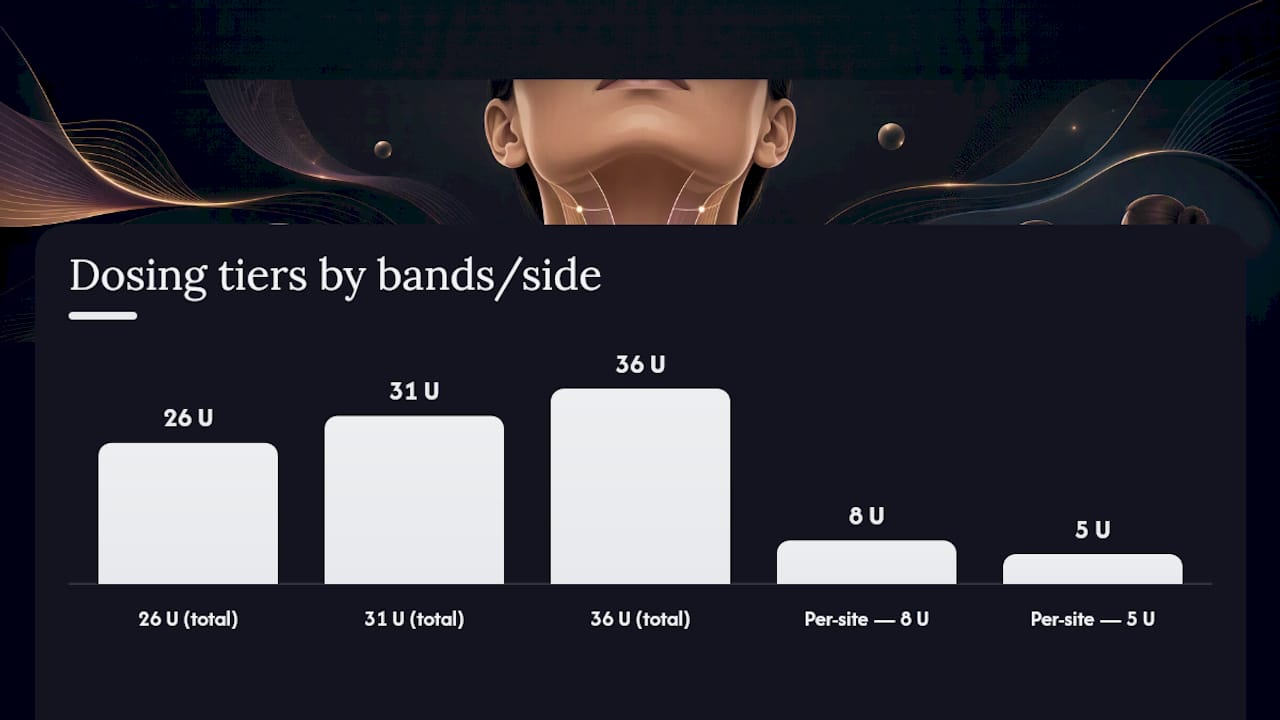
Table of Contents
What is the platysma, and why do neck bands form?
The platysma is a broad, thin sheet of muscle that runs from the upper chest and shoulder area up through the neck, attaching along the lower jawline and blending into the lower face. Because it spans such a wide area, it influences both neck contour and jawline definition. When it contracts, you can see and feel it pull the corners of the mouth downward and tighten the skin of the neck.
Dynamic versus static bands — why the distinction matters:
-
Dynamic bands appear when the platysma actively contracts. They are caused by the muscle itself pulling against the overlying skin and are the primary target for neuromodulator treatment.
-
Static bands are visible even at rest. They reflect skin laxity, loss of subcutaneous fat, or subplatysmal fat herniation rather than active muscle contraction alone. Neurotoxin helps less here.
-
Self-check: Ask your provider to have you tense your neck (as if straining) during the consultation. Bands that appear prominently with that contraction are dynamic and respond well to injection. Bands visible at rest with no change on contraction point toward a laxity or structural component.
-
Band count: Most patients present with one or two bands per side. Anatomical variation is significant, which is why a dynamic in-clinic assessment is essential for a tailored injection plan rather than a one-size approach.
Pro Tip: Dynamic bands respond best to neuromodulator injections like BOTOX Cosmetic. If your bands are visible at rest and don’t change much when you tense your neck, mention that to your injector — static changes may call for fillers, energy-based skin tightening, or a surgical consult rather than neurotoxin alone.
How botulinum toxin reduces platysma prominence
OnabotulinumtoxinA works by blocking acetylcholine release at the neuromuscular junction, which temporarily reduces the platysma’s ability to contract. Less contraction means less visible banding and a softer, smoother neck contour. The effect is temporary because nerve terminals eventually regenerate their signaling capacity.
The FDA-approved indication for BOTOX Cosmetic covers temporary improvement in moderate-to-severe vertical bands connecting the jaw and neck in adults. This is a labeled, on-indication use — not an off-label application. For readers who want a deeper primer on how neurotoxins work in aesthetic medicine, the mechanism applies consistently across facial and neck targets.
Statistic: Two multicenter Phase III trials found statistically significant and clinically meaningful improvements in platysma prominence at Day 14 for onabotulinumtoxinA (26, 31, or 36 U) versus placebo, with higher patient satisfaction and no dysphagia events reported in either trial.
Trial follow-up extended through Day 120, showing a gradual decline in effect over that period — consistent with the temporary nature of neurotoxin results across all indications. Patients also reported reduced psychosocial impact and less bother with their jawline and neck band appearance compared with the placebo group, which means the benefit goes beyond what a clinician grades on a scale.
Label dosing and the practical 8/5 rule
The BOTOX Cosmetic prescribing information provides three total-dose options tied to how many bands a patient presents with. The 8/5 rule described in HCP materials translates those totals into a per-site injection plan that is easy to follow in practice.
The jawline component uses four injection sites per side at 2 U each (8 U per side). Each vertical band receives five injections at 1 U each. Per-site volumes follow the label’s reconstitution guidance; your provider will draw the appropriate volume based on how the vial is reconstituted.
Pro Tip: Providers individualize within and around these label totals based on band prominence, muscle mass, and prior neurotoxin history. Men often carry more platysma mass and may need dosing toward the higher end. If you’ve had neurotoxin before, let your injector know — prior treatment history and bite-muscle bulk both factor into the plan.
How trained injectors perform the procedure safely
Technique is where outcomes are won or lost with platysmal band botox. The steps below reflect published clinical guidance and the pinch-and-isolate approach recommended in PMC technique reviews.
Injection sequence and geometry:
-
Map first: The patient tenses the neck (bearing down or grimacing) so the injector can mark the bands clearly before any product is placed.
-
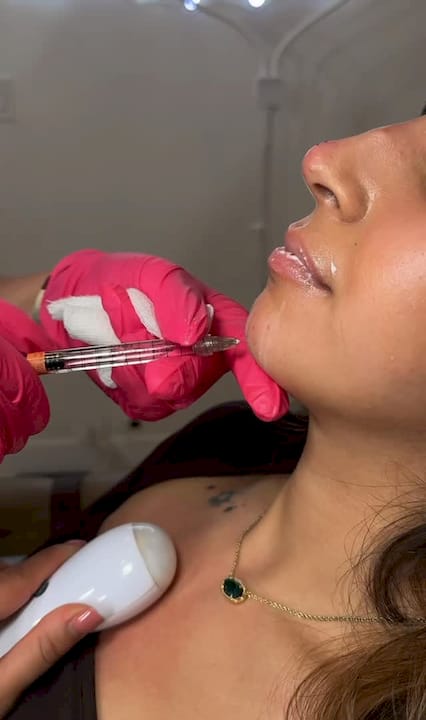
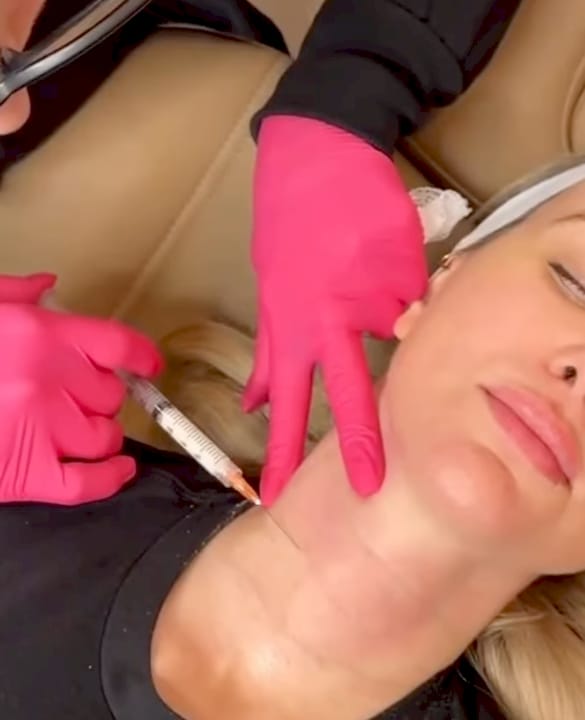
Pinch to isolate: The injector grasps the band between thumb and forefinger, lifting it away from deeper neck tissues. This reduces the risk of toxin diffusing to muscles below the platysma.
-
Superficial intramuscular depth: The needle enters perpendicular to the skin at a shallow angle, targeting the platysma itself rather than deeper structures.
-
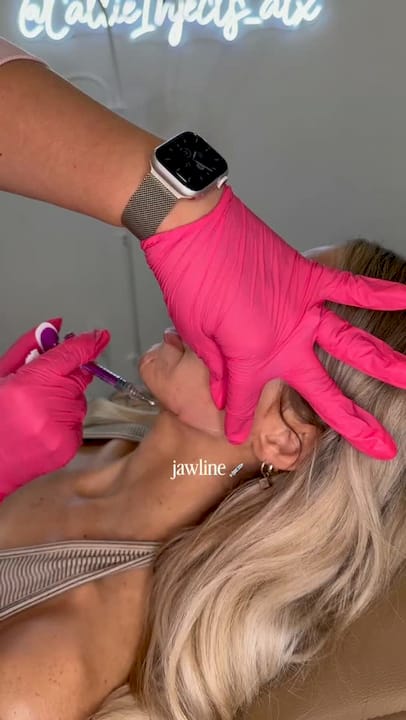
Jawline injections: Placed approximately 1–2 cm inferior to and parallel with the mandibular border, spaced evenly across four sites per side.
-
Band injections: Five sites per band, spaced approximately 1–2 cm apart vertically. The most superior injection sits roughly 1–2 cm below the jawline injection row.
-
One-finger-breadth rule: No injection should be placed within one finger breadth of the mandibular border. Injecting too close risks diffusion into the masticatory muscles, which can cause lower-lip weakness or asymmetry.
Anatomical variation in platysma course means the injection map should be customized to each patient rather than applied as a fixed template. Some patients have bands that run more medially; others have wider or more lateral presentations. A provider who maps dynamically in-session will produce more consistent results than one who follows a rigid grid.
Pro Tip: Schedule your follow-up at two weeks rather than going back sooner. The full effect takes about 14 days to develop, and assessing before then risks unnecessary touch-up dosing. Small adjustments at two weeks are far safer than large initial doses.
Who is a good candidate for platysma band treatment?
Not every neck concern responds to neurotoxin alone. A thorough assessment before treatment protects you from spending money on a procedure that won’t address your actual concern.
Assessment steps a provider should perform:
-
Ask you to contract the platysma to identify dynamic bands and count them per side.
-
Evaluate band thickness and prominence at rest versus during contraction.
-
Assess skin laxity by gently pinching the neck skin — significant excess laxity suggests a structural component neurotoxin won’t resolve.
-
Check for subplatysmal fat, which can push bands forward and reduce the visual improvement from neurotoxin alone.
-
Evaluate jawline definition and jowling, since platysma hyperactivity can contribute to jowl descent over time.
Good candidates are adults with moderate-to-severe dynamic bands, reasonable skin tone, and no significant subplatysmal fat excess. Patients who see a clear difference in band prominence between relaxed and contracted states tend to respond best.
Contraindications and precautions include pregnancy or lactation, active infection at the injection site, known hypersensitivity to botulinum toxin or any component of the formulation, and certain neuromuscular disorders (such as myasthenia gravis or Lambert-Eaton syndrome). Patients on anticoagulants should discuss bruising risk with their provider before treatment.
When to consider other options: Pronounced skin laxity, heavy subplatysmal fat, or a hanging platysma that is visible at rest without significant dynamic change often warrants a surgical consultation (platysmaplasty or neck lift) or a combination approach with energy-based devices. Understanding why neurotoxin is chosen for facial rejuvenation helps set realistic expectations for what it can and cannot do on its own.
What to expect: the treatment experience and timeline
Knowing what happens in the room — and in the days after — makes the whole process feel much more manageable.
-
Consultation and mapping (10–15 minutes): Your provider reviews your neck anatomy, asks you to contract the platysma, marks the injection sites, and confirms the total unit plan.
-
Sterility and prep: The area is cleansed; some providers apply a topical numbing agent, though most patients find the injections tolerable without it.
-
Jawline injections first: Four sites per side along the mandibular border, then the band injections working downward from the most superior site.
-
Total appointment time: Most sessions run 20–30 minutes from start to finish, including mapping and post-injection review.
-
Onset: Mild softening of the bands typically appears within a few days.
-
Peak effect: Full results are visible around Day 14, which is why the Phase III trials used that timepoint as the primary efficacy assessment.
-
Duration: Effect gradually declines through the follow-up period observed in trials (through Day 120), with most patients considering retreatment in the several-months range.
-
After treatment: Expect mild soreness, possible bruising, and minor redness at injection sites. Avoid vigorous neck massage, heavy exercise, and lying flat for several hours post-treatment. Review pre-appointment preparation steps to reduce bruising risk before your visit.
Pro Tip: Book your two-week follow-up at the same time you book your treatment. Documenting your response at that visit gives your provider the data to plan retreatment timing and any small touch-ups — and it keeps you from guessing when to come back.
Safety profile and how risks are minimized
The safety record for platysmal band botox at label doses is reassuring. Phase III trial data showed adverse event incidence in the onabotulinumtoxinA arms was consistent with the known safety profile of BOTOX Cosmetic in other indications, and no dysphagia events were reported in either trial.
Statistic: In the Phase III trials, adverse event rates in the onabotulinumtoxinA group were comparable to placebo, with no confirmed cases of toxin spread to adjacent structures when treatment followed the labeled dosing and technique.
Common local reactions include injection-site pain, bruising, and mild erythema. These are expected and typically resolve within a few days.
Less common but important risks:
-
Local muscle weakness in the neck, which can affect head posture if deeper muscles are inadvertently affected.
-
Historically, dysphagia (difficulty swallowing) has been a documented risk with higher-dose or imprecise platysma injections. The Phase III trials reported zero dysphagia events, attributed to the controlled dosing and technique protocol.
-
Lower-lip asymmetry if product diffuses toward the depressor anguli oris or other perioral muscles.
Risk-reduction strategies providers use:
-
Pinch-and-isolate technique to lift the band away from deeper tissues before injecting.
-
Superficial intramuscular depth to keep product within the platysma.
-
Strict one-finger-breadth margin below the mandibular border.
-
Conservative label-based dosing with planned follow-up rather than aggressive initial dosing.
The prescribing information on DailyMed details the full adverse event profile and contraindications; reviewing it with your provider before treatment is reasonable.
What does platysma band treatment cost in the U.S.?
Pricing for neck band botox in the U.S. is unit-based, so the label dosing tiers translate directly into cost estimates. No single price applies universally — provider experience, geographic market, and facility type all shift the number.
Key cost drivers:
-
Total units used: Label dosing ranges from 26 to 36 units depending on band count.
-
Per-unit price: Varies by provider and market; Austin and San Antonio markets sit within the broader Texas range.
-
Provider credentials: Board-certified physicians, nurse practitioners, and physician assistants with aesthetic specialization typically command higher per-unit rates — and the technique precision that justifies them.
-
Combination procedures: Adding jawline filler or energy treatments in the same session affects total visit cost.
-
Follow-up policy: Some clinics include a two-week check in the treatment fee; others bill it separately.
Illustrative unit-based example: At a hypothetical per-unit price, multiply that rate by 26, 31, or 36 to estimate the neurotoxin cost alone. Facility fees and consultation charges may be added on top. This is a calculation framework, not a quote — actual pricing varies and should be confirmed with your provider.
Insurance does not cover cosmetic platysma band treatment. Medical indications for botulinum toxin (such as cervical dystonia) follow a different coverage pathway entirely and are not applicable here.
Pro Tip: Ask for an itemized quote that separates the neurotoxin cost, any facility fee, and whether the two-week follow-up is included. A provider who bundles the follow-up is signaling they take outcome assessment seriously — that’s worth factoring into your decision.
When Botox alone may not be enough
Neurotoxin is a powerful tool for dynamic platysma bands, but it has clear limits. Recognizing those limits early saves time and money.
Non-surgical complements that pair well with neurotoxin:
-
Dermal fillers along the jawline can restore lost volume and sharpen definition, complementing the muscle-relaxing effect of the neurotoxin. Jawline contouring with injectables is a natural pairing for patients who want both band reduction and improved jaw definition.
-
Energy-based skin tightening (radiofrequency, ultrasound-based devices) addresses skin laxity that neurotoxin cannot correct.
-
Microneedling with RF improves skin texture and mild laxity, particularly useful for patients with early-stage tech neck lines alongside dynamic bands.
-
Submental fat reduction (such as injectable deoxycholic acid) targets subplatysmal fat that pushes bands forward, improving the overall result when combined with neurotoxin.
Surgical options become relevant when skin laxity is pronounced, when the platysma has separated significantly at the midline, or when a hanging platysma is visible at rest without a meaningful dynamic component. Platysmaplasty and neck lift procedures address structural changes that no injectable can replicate.
The combination sweet spot: Moderate dynamic bands plus mild skin laxity often do best with neurotoxin paired with an energy device or filler. Severe laxity or a predominantly static presentation warrants a surgical referral before investing in repeated neurotoxin cycles.
Questions to ask your provider before booking
Bring this checklist to your consultation. The answers will tell you a great deal about whether the provider is the right fit.
Provider credentials and experience:
-
Are you a licensed medical professional with specific training in aesthetic neurotoxin injections?
-
How many platysma band treatments have you performed, and can you show before-and-after photos of similar cases?
Injection plan and product:
-
Which product will you use, and is it FDA-approved for this specific indication?
-
What is the total unit plan for my presentation, and which dosing pattern (26, 31, or 36 U) applies to me?
-
Will you map my bands dynamically during the appointment before injecting?
Safety and follow-up:
-
What technique do you use to minimize the risk of diffusion to deeper muscles?
-
Is a two-week follow-up included, and what is your policy for touch-ups if the result is asymmetric?
-
What is your protocol if I experience unexpected weakness or swallowing difficulty after treatment?
Setting and oversight:
-
Is this a medical setting with emergency protocols in place?
-
Who provides medical oversight if a complication arises?
Red flags include providers who cannot explain the injection map, who propose very high unit totals without a clear rationale, or who skip the dynamic assessment and go straight to marking sites on a resting neck.
An editorial perspective on platysma band treatment
The conversation around neck rejuvenation has shifted considerably since BOTOX Cosmetic received its FDA approval for platysma bands in October 2024. Before that approval, platysma injections were common but technically off-label, which meant dosing varied widely across practices — sometimes reaching 100 units or more in older academic literature. The label’s 26/31/36-unit framework is genuinely conservative by historical standards, and the Phase III data showing no dysphagia events at those doses is meaningful.
What gets underestimated is how much technique matters relative to total dose. Two providers using the same 36 units can produce very different outcomes depending on whether they map dynamically, isolate the band before injecting, and respect the mandibular border margin. The drug is the same; the result is not. Patients who focus only on price per unit and skip the question of technique are optimizing the wrong variable.
There is also a tendency to treat platysma bands in isolation when the neck and lower face are a connected system. A patient with prominent bands and significant jowling will see a more complete result from a combined approach — neurotoxin for the bands, filler or energy for the jawline — than from neurotoxin alone. The FDA label covers the bands; the clinical judgment covers the whole picture.
Ready to have your neck bands assessed by our team?
At The Injection Room, we approach platysmal band treatment the same way we approach every neurotoxin service: with a full lower-face and neck assessment before a single unit is placed. Our injectors map bands dynamically, follow label-based dosing as the baseline, and schedule a two-week follow-up to document your response and plan any conservative touch-ups. No guesswork, no aggressive overdosing.
We serve patients across Austin and San Antonio, Texas. If you’re ready to find out whether you’re a good candidate for neck band treatment, book a neurotoxin consultation with our team. You can also visit our San Antonio neurotoxins page or Austin neurotoxins page to learn more about what to expect and how to get started.
Sources
The sources below are the primary references for the clinical data, dosing guidance, and technique information in this article.
-
BOTOX COSMETIC- onabotulinumtoxina injection, powder, lyophilized, for solution - DailyMed
-
BOTOX® Cosmetic (onabotulinumtoxinA) platysma bands indication
This article is general information, not a substitute for advice from a qualified doctor. Consult a qualified healthcare professional about your own circumstances before acting on anything here.
FAQ
Does Botox for platysmal bands actually work?
Yes. Phase III trials demonstrated statistically significant improvement in platysma prominence at Day 14 versus placebo, with higher patient satisfaction in the onabotulinumtoxinA group. Results are temporary and most pronounced in patients with dynamic (contraction-driven) bands.
What is the riskiest part of platysma band injections?
Injecting too close to the mandibular border or too deeply risks diffusion into masticatory muscles, potentially causing lower-lip weakness or asymmetry. Historically, imprecise high-dose injections carried a risk of dysphagia; the Phase III trials reported no dysphagia events using the label protocol and pinch-and-isolate technique.
How much does platysmal band Botox cost in the U.S.?
Cost depends on total units used (26, 31, or 36 per the label), the provider’s per-unit rate, and geographic market. Multiply your provider’s per-unit price by the applicable unit total for a baseline estimate, then confirm whether the two-week follow-up visit is included or billed separately.
Does platysma Botox help with jowls?
It can contribute to a modest improvement in jawline definition, since platysma hyperactivity pulls the lower face downward. However, significant jowling typically requires dermal filler, energy-based tightening, or surgical correction in addition to neurotoxin for a meaningful result.

%20Pictures%20are%204%20weeks%20apart..jpg)